Borrowed Intelligence
On intuition, trust, and the human network behind the machine

Twenty watts
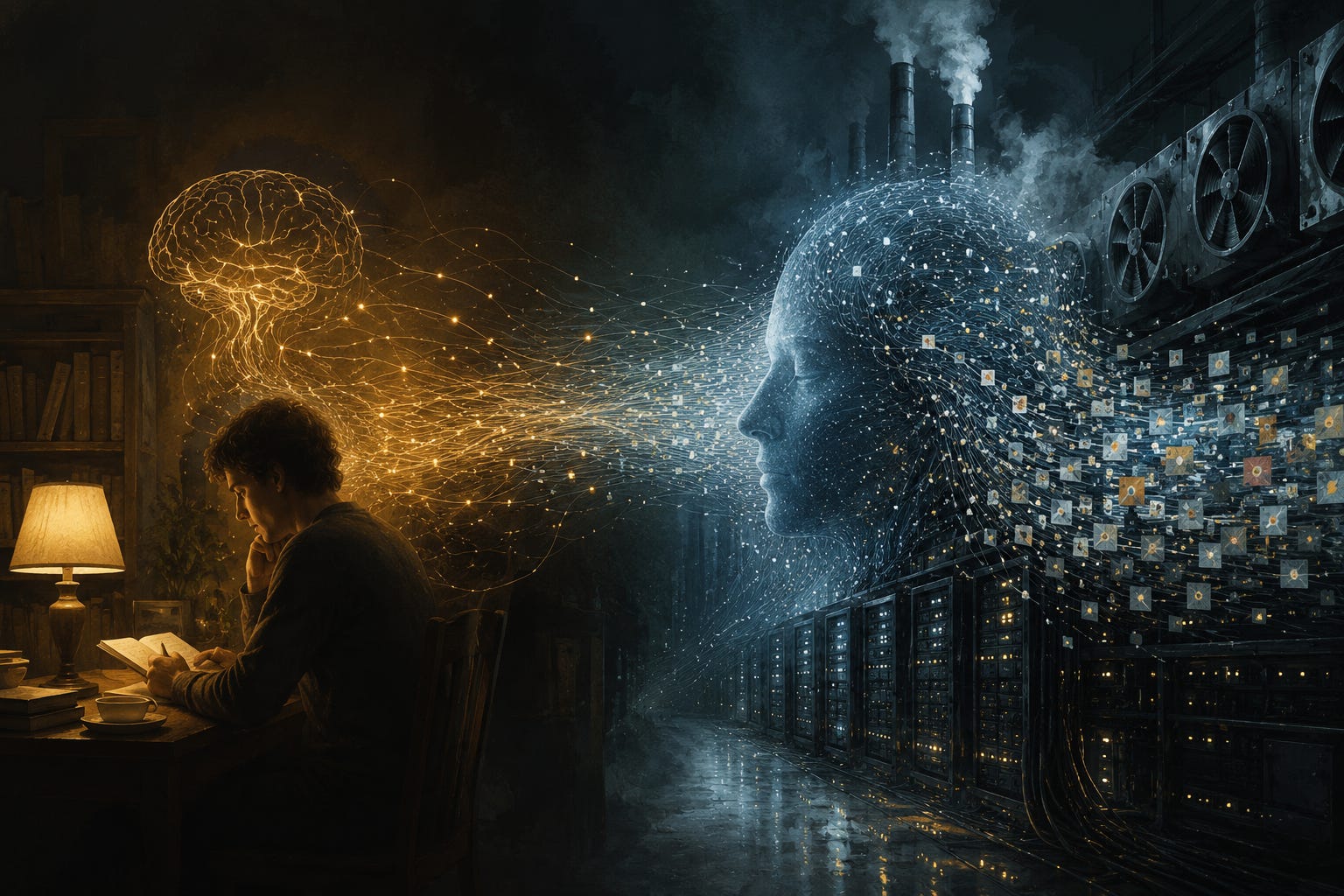
The human brain runs on about 20 watts. A lightbulb. Over an eighty-year lifetime that comes out to around fifteen megawatt-hours of neural activity — less than a mid-sized office building uses in a year. Training a single frontier AI model, by contrast, runs on tens of megawatts of continuous draw for months and consumes tens of gigawatt-hours in total. Very roughly, the energy equivalent of a few thousand human lifetimes of thinking.
It isn’t only a matter of energy. A human on 20 watts can follow a book from start to finish, hold a multi-year project in their head at some level of abstraction, track the thread of a conversation that’s been going for hours. A writer can draft a novel over a few nights on coffee and cigarettes. We forget things and confuse people and rewrite our own memories, but we hold coherent projects together over months and years, not over a few thousand tokens. Current AI models are advertised with context windows of hundreds of thousands or even millions of tokens, and on synthetic benchmarks they do look strong. The practical reality is that quality degrades well before the advertised limit. Models lose information in the middle of long contexts, confuse earlier turns, hallucinate details that weren’t there. The gap in sustained coherence is larger than the marketing suggests.
We say AI is becoming smarter than humans. But we’ve built a system that spends enormous amounts of energy to approximate what a brain does on the power draw of a reading lamp, and still has a different failure profile over distance. The comparison is strange, and it doesn’t resolve by comparing one brain to one training run — that isn’t the right unit on either side. But the strangeness is a useful place to start. It suggests the two systems are doing something architecturally different, and that the comparison we usually reach for flattens the difference in a way that leads to wrong conclusions. The decisions about how to use AI are coming either way. Better they rest on a real reading of the thing.
Intelligence is not what this is
We call these systems Artificial Intelligence. A better name would be Artificial Intuition.
Intelligence, as we usually mean the word, implies reasoning: premises, steps, conclusions — a path we can trace and check. Intuition is the opposite. A judgment arrives whole, without a visible path, drawn from patterns absorbed from somewhere we can no longer point to. We can sometimes explain it afterward, but the explanation is a reconstruction, not a transcript.
This is what an LLM does. It compresses a vast amount of data into internal representations nobody fully understands, and when asked a question it produces an output that feels confident and often correct but whose derivation cannot be traced step by step. Ask it to explain itself and it generates an explanation — another intuitive production, not a reading from a log. At the moment it answers, the model cannot point to its sources or expose its reasons, because in any inspectable sense it does not have them.
Newer models that show their work don’t change this. We can watch a model reason through a problem before answering, and we can read the steps — but the steps are more output from the same pattern-matcher that produced everything else. There is no separate reasoning module underneath, consulting the chain of thought and drawing conclusions from it. It was trained to look useful, and it does improve answers on hard problems, but it isn’t a record of how the model thought. The structure is real and it helps. It still isn’t a window into a mechanism.
The same goes for the fact that the model isn’t guessing randomly — that each token comes from a statistical distribution shaped by an enormous, optimized training process. Being determined by an optimized process and producing traceable reasoning are different properties, and only the second is what reasoning means. A pinball machine’s layout is carefully designed and the ball’s path is fixed by physics, yet neither fact gives you a step-by-step justification for where it lands. A model can be entirely non-random — same input, same output, every time — and still compute each answer in one holistic operation, with no recoverable chain of inference inside it. Optimization builds the capacity to answer; it doesn’t lay down a path through any particular answer that the system can later walk back along. That a distribution was learned rather than stumbled into is a precise description of how intuition is built: patterns absorbed over long exposure, applied whole, without inspectable steps. The doctor who diagnoses in seconds, drawing on twenty years of cases they can no longer individually recall, is running on something optimized too.
This is why AI fails the way it does. Confidently wrong. Biased in ways it can’t see. Susceptible to framing. Bad at precise computation, good at style and pattern. These are intuition’s failure modes. The hallucination problem isn’t a bug in a logical engine; it’s intuition doing what intuition does when nothing else is there to check it.
Human intelligence is a network
If we’re going to compare human intelligence to AI, we need to be clear about what human intelligence actually is. And it isn’t what we usually picture when we say the word.
The picture we carry around is of an individual mind thinking. One person, reasoning through a problem, producing an insight. That’s the unit we compare to AI: one smart human versus one smart model. By that measure the question becomes “is the model smarter than the person,” and we can plot benchmark scores and announce milestones.
But this has never been how human intelligence actually worked. A single human alone in a room doesn’t invent calculus or build a city. What makes humanity intelligent in the way that matters — the way that produces science, institutions, technology, culture — is that humans are networked. We communicate. We pool what we know. We build on what prior generations figured out and hand forward what we add. The intelligence is in the system, not the node.
Each of us is an agent with limited capacity, limited memory, a narrow range of training, a specialized role. We get leverage not by being individually brilliant but by being able to exchange information with other agents who have different training, and by being embedded in institutions — language, science, markets, the law — that accumulate what individual agents figure out and carry it forward across generations. One human is a modest agent. Humanity, as a communication network across centuries, is an extremely strong one.
The model is, in the end, a compression of this network. Every model is trained on text humans produced. The substantive content — what’s actually known about physics, law, medicine, literature — traces back to a relatively small number of authors, sitting on a much broader base of everyday writing, code, and recorded conversation that gives the model its fluency. Both layers are inherited from us. When the model produces something that looks intelligent, it is mostly surfacing compressed patterns from that corpus. The intelligence the model appears to have is, to a large extent, borrowed intelligence from the human network that produced its training data.
This isn’t a dismissal. Compression at that scale is a real achievement. The ability to query centuries of human writing fluidly, in natural language, at any hour, is a new kind of access, and the people using it well are getting real leverage out of it. But it reframes the comparison. It is not one model versus one human. It is a compressed snapshot of humans who wrote things down versus one live human still connected to the network. The model is downstream of the thing it is being compared to.
AI doesn’t have its own network yet, either. Each instance of a model is alone. It doesn’t talk to other instances, doesn’t accumulate knowledge across runs, doesn’t build institutions, doesn’t hand forward what it learned to its successor in any deliberate way. The training process is the only channel of cumulative learning, and it’s controlled from outside, not by the models themselves. Whether this changes is an open question. Until it does, comparing one model to one human is comparing a compressed artifact to a live agent, and missing that human intelligence was never really located in one agent in the first place.
This also resolves the energy strangeness from the opening. Comparing one brain to one training run was never the right comparison. A brain is a single node; a training run produces a compressed artifact of the network. The fair comparison would be something like “humanity as a cumulative system” versus “all of AI’s training and inference infrastructure,” and the essay is not going to try to settle that. The point was never about whose total energy budget is lower. The point is that the two systems have different architectures, and the human one has features — specialization, cheap communication between differently-trained agents, cumulative knowledge handed forward across generations — that the AI one does not yet have. A single node can run on 20 watts and still contribute to something enormous because the architecture does the heavy lifting. AI instances are expensive in part because they don’t yet have that architecture, so each one has to carry more of the load on its own.
The well
If the model is a compression of human output, then take the input away and it has nowhere to go. It can recombine what it already has, but it can’t expand the distribution. It can’t observe the world and bring back something new. It has no live input channel. Humans do.
Imagine that LLMs begin to replace the humans who produce the material. Who then writes the new books? Who writes the new code? Who has the new experiences that become the new conversations that become the new training data? If the answer is “the model itself,” the arithmetic stops working. When models are trained on outputs from earlier models, the distribution narrows. The rare, the weird, the original — the tails where most novelty lives — gets compressed away. Each generation becomes more average, more confident, more subtly wrong in the same ways. Researchers call this model collapse, and it isn’t hypothetical. It has been demonstrated. It’s why frontier labs pay for fresh human-produced data and filter synthetic data carefully. The well has to stay full.
This reframes what AI is for. It isn’t here to replace the human production of original content. It’s here to work with it — to retrieve, remix, translate, explain, apply. Used this way, it’s one of the most leveraging tools we have ever had. Humans remain the source. AI is the multiplier. Invert this — let AI become the primary producer and humans the consumers — and the system starts to unwind. The models degrade because their food supply degrades.
So the practical question becomes a question about us, not about the models. Do we keep reading deeply. Do we keep writing carefully. Do we keep doing original research, having real conversations, producing work from lived experience. The health of AI turns out to be downstream of the health of the human knowledge ecosystem. There’s an alignment of interests here. The labs want their models to keep improving, and that depends on humans continuing to do the thing AI can’t do for itself. Which is also why replacing rather than augmenting, or automating the generative parts rather than the tedious ones, tends to work against the thing it is trying to build.
The tradition we reversed
For several centuries now we have worked hard to elevate reasoning — the kind of thinking that shows its work — over intuition. The scientific method was part of this project; so were law, accounting, engineering, and the slow professionalization of medicine. All of these rest on roughly the same premise: a claim we can trace is worth more than a claim we can’t, and a judgment whose path isn’t visible deserves some suspicion until the path is made visible.
These disciplines didn’t just prefer traceable reasoning in principle. They built practices around it — peer review, written opinions, appeals courts, audits, code review, double-entry bookkeeping, reproducibility, the whole apparatus of showing your work so someone else can check it. The practices exist because even careful reasoning, done by a human who is tired or distracted or biased, fails often enough that we don’t trust the output of any single head without external checks. Surgeons make more mistakes late in long shifts. Analysts miss things when they’re motivated to miss them. The reasoning faculty is the same in both cases; the conditions it runs on are not. Modernity didn’t only elevate reasoning. It built the practices that let reasoning actually function across a society, precisely because reasoning on its own, inside one head, is not enough.
Traceability and the practices are not two separate things. They are the same thing seen from two sides. The reason modernity demanded that work be shown was not that legible reasoning is intrinsically more trustworthy than a hunch — a proof nobody checks, a ledger nobody audits, a diagnosis nobody second-opinions is no better than a hunch. Showing the work mattered because showing the work is what makes the practices possible. Peer review needs a paper to review. An auditor needs books to open. Code review needs readable code. The demand for legibility and the institutions of accountability were never two things. They were the same thing, viewed from the inside and from the outside.
Then the most reasoning-oriented disciplines we have — computer science, mathematics, engineering — built a machine whose central capacity is intuition. Not reluctantly, and not as a side effect, but as the thing that makes the machine work at all. We now use it to help with law, medicine, science, and decision-making at scale — the domains modernity built these practices around. And we use it without those practices. An LLM’s output doesn’t go through peer review. It doesn’t sign its name. It doesn’t get cross-examined by opposing counsel. It isn’t on call when the system it designed fails at 3am. It produces a judgment and hands it to us, and we decide whether to use it — and increasingly, people don’t decide. They paste it into the next thing.
Intuition alone, without the practices around it, was never how modern institutions worked. We are now pretending it can be.
Trust from the outside
When we see an output from AI that seems wrong — a confident hallucination, a biased recommendation, a plausible-sounding mistake — we tend to say the system has failed us by being opaque. If only we could see inside, we could trust it. This framing is almost always wrong, and it is wrong in a way that matters for how we use these systems.
We don’t trust humans because we can see inside their heads. We can’t. We trust them because of what surrounds their judgments. A doctor is trusted not because we have a window into their diagnostic reasoning but because they went through training, they carry malpractice exposure, they work inside a hospital with review boards, their peers can overrule them, their license can be pulled, their outcomes are tracked. A software engineer’s code is trusted not because the reasoning was legible but because it went through review, it’s version-controlled, the system it runs in is monitored, someone is paged when it breaks. An accountant’s numbers are trusted because they’re audited. Take any of these practices away and the output becomes much less trustworthy — even if the individual human is exactly as competent as before. The trust lives in what surrounds the judgment, not in the head that produced it.
This is the shape of trust we actually have, and it’s a property of accountability, not of cognition. The reason AI raises a new kind of trust problem isn’t that it is uniquely opaque — plenty of human judgments are opaque, and we trust them anyway. It’s that the accountability we built around human judgment doesn’t transfer to the model. An instance of a model doesn’t have a track record across years. It doesn’t face consequences shaped over a career. It isn’t licensed, reviewed, audited, or held to account in any of the ways human professionals are. When the model is wrong, no one who was in a position to prevent the error faces the cost of it. That is the novel problem — not what’s inside the model, but what isn’t around it.
There is a drift in how AI gets talked about — a sense that humans are the weak link, the unreliable node, the thing that should be routed around wherever possible. The argument of this essay is the opposite. The knowledge the model has, it has because of us. The architecture that has made human intelligence work at the scale it works at — cheap nodes, networked, cumulative, specialized — is something AI does not yet have, and until it does the comparison between one model and one human is the wrong picture of what is on either side. The reasoning faculty the model lacks is something we still have, however imperfectly. And the accountability that makes any of this trustworthy is not something a model can participate in on its own — it exists because humans are embedded in practices, institutions, and consequences that a compressed artifact cannot be embedded in.
AI is one of the most leveraging tools we have ever built. It earns that leverage as a multiplier of human work, not as a replacement for it. Treat it as a replacement — automate the generative and the judging, route around the humans whose continued practice is what the whole thing runs on — and the system degrades. The models’ food supply degrades. The accountability around the work thins out. The network that produced the intelligence in the first place weakens. Used the other way, as a multiplier applied to people who are still reading deeply, writing carefully, taking responsibility for the work that leaves their hands — it does something new and valuable that no previous tool has done.
The decision about which way we use it is not one the models will make. It’s the one part of this situation that is still ours.